New! March 2011
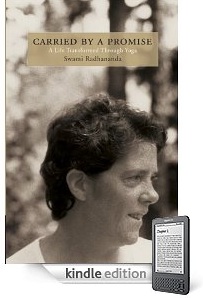 Carried by a Promise
now available on Kindle
Swami Radhanada’s most recent book, Carried by a Promise is now available for the e-book reader, Kindle.
Download your copy of Carried by a Promise and start reading right away. Your Kindle book can also be read on your computer, iPhone/iPad, Android or BlackBerry device so even if you don’t have a Kindle you can still enjoy an e-version of this inspiring book.
Read, listen, reflect and change...
At timeless we believe that beautiful books inspire our learning.
In the spirit of the rich tradition of yoga, timeless continues to evolve and challenge the traditional publishing model. As a Canadian micro-publisher we provide an accessible approach to many traditional and new technologies, keeping at heart the desire and the power to transform. We are engaged in green practices that support our natural resources by using post-consumer waste (PCW) paper, vegetable-based inks, print-on-demand and digital distribution. Timeless is committed to publishing the teachings of Swami Sivananda Radha, as well as works by her students and other new and inspiring authors.

Swami Radhananda's blog
Featuring articles from her upcoming books!
 Swami Radhananda has now started posting on her blog. Some excerpts from her upcoming book and satsang videos will be featured on a weekly basis. Keep visiting the site and please offer a donation towards the creation of these inspiring books.
Visit her Blog now!
Swami Radhananda has now started posting on her blog. Some excerpts from her upcoming book and satsang videos will be featured on a weekly basis. Keep visiting the site and please offer a donation towards the creation of these inspiring books.
Visit her Blog now!
Now Available!
On Sanyas
 Sanyas is the Yoga of Renunciation. The practice of sanyas or swamihood is said to be the most effective tool to obtain liberation.
Swami Sivananda Radha offers a unique perspective on sanyas and how this ancient practice continues to be a relevant and living tradition in the West.
more
Sanyas is the Yoga of Renunciation. The practice of sanyas or swamihood is said to be the most effective tool to obtain liberation.
Swami Sivananda Radha offers a unique perspective on sanyas and how this ancient practice continues to be a relevant and living tradition in the West.
more
Timeless News
first carbon neutral book!
 We are happy to announce the immediate availability of our first carbon neutral printing initiative. For our new edition of the Divine Light Invocation, we at Timeless decided to work with Hemlock... more